Portal 02 / Generation One

Personal technology.
With a point of view.

The first generation of MOSKO hardware. Seven projects, each at its own stage of development. Everything described here is a design goal, not a finished product.

Design withheld until the revealNo renders, no silhouettes, no hints.
Gen One / 01In development

NetRunner

First showing: COMPUTEX 2027, Taipei, June 1–4.

NetRunner is MOSKO’s personal computing and control platform, built around a trakarskop, our trackball-style control, and an architecture of specialized background processes called daemons. The system is being developed so Binat Natonim can coordinate permitted tasks across connected tools while you focus on other activities. From workshop equipment to personal computers, the aim is practical control that stays accountable to its owner.

Its physical design stays under wraps until then. NetRunner will be shown at COMPUTEX 2027: the final version if it’s ready, an advanced prototype if it isn’t.

Price commitment
Below USD 800*
Visual design
To be revealed
Availability
To be announced

*Included configuration, regional pricing, tax, shipping, and optional accessories will be specified before ordering opens.

Also on the workbench

Six more in development.

The images below are AI-produced concepts, not final designs. Hand-drawn sketches will replace them as each design matures.

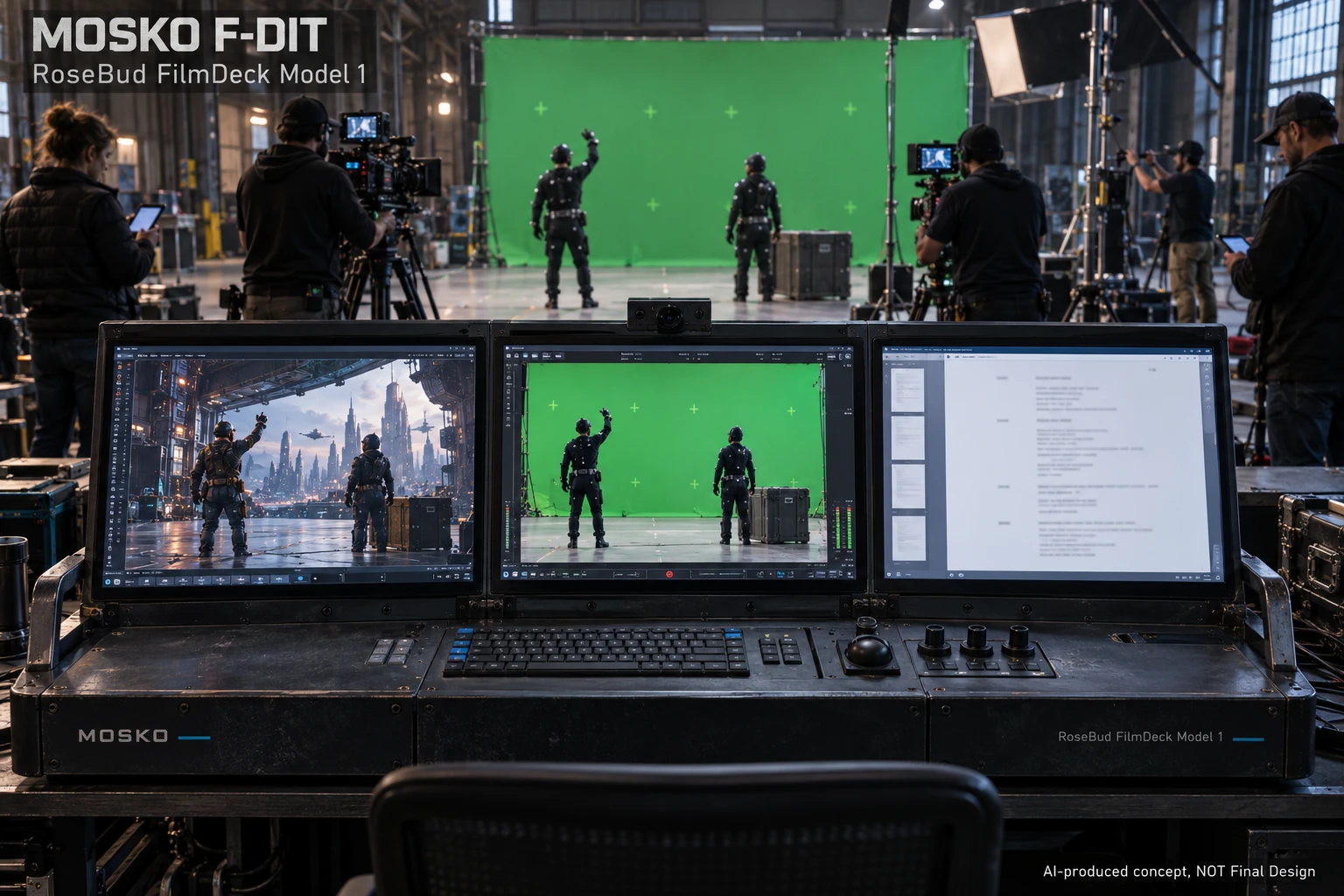
Concept render of a three-screen production console on a green-screen film set, showing a VFX composite, the raw stage feed, and a screenplay.
AI-produced concept, NOT Final Design

Gen One / 02

MOSKO F-DIT ROSEBUD FILMDECK MK 1

In development. Workflows and compatibility under development.

Rosebud FilmDeck is being developed as a dedicated computer console for productions, shaped around the work of directors, cinematographers, and set managers. Its intended workflows bring live editing, VFX control, and studio coordination into one working environment. Future camera interoperability, including research into IMAX’s newer camera systems, is part of the development roadmap. The goal is a practical production console that connects creative decisions with the equipment and information needed to carry them out.
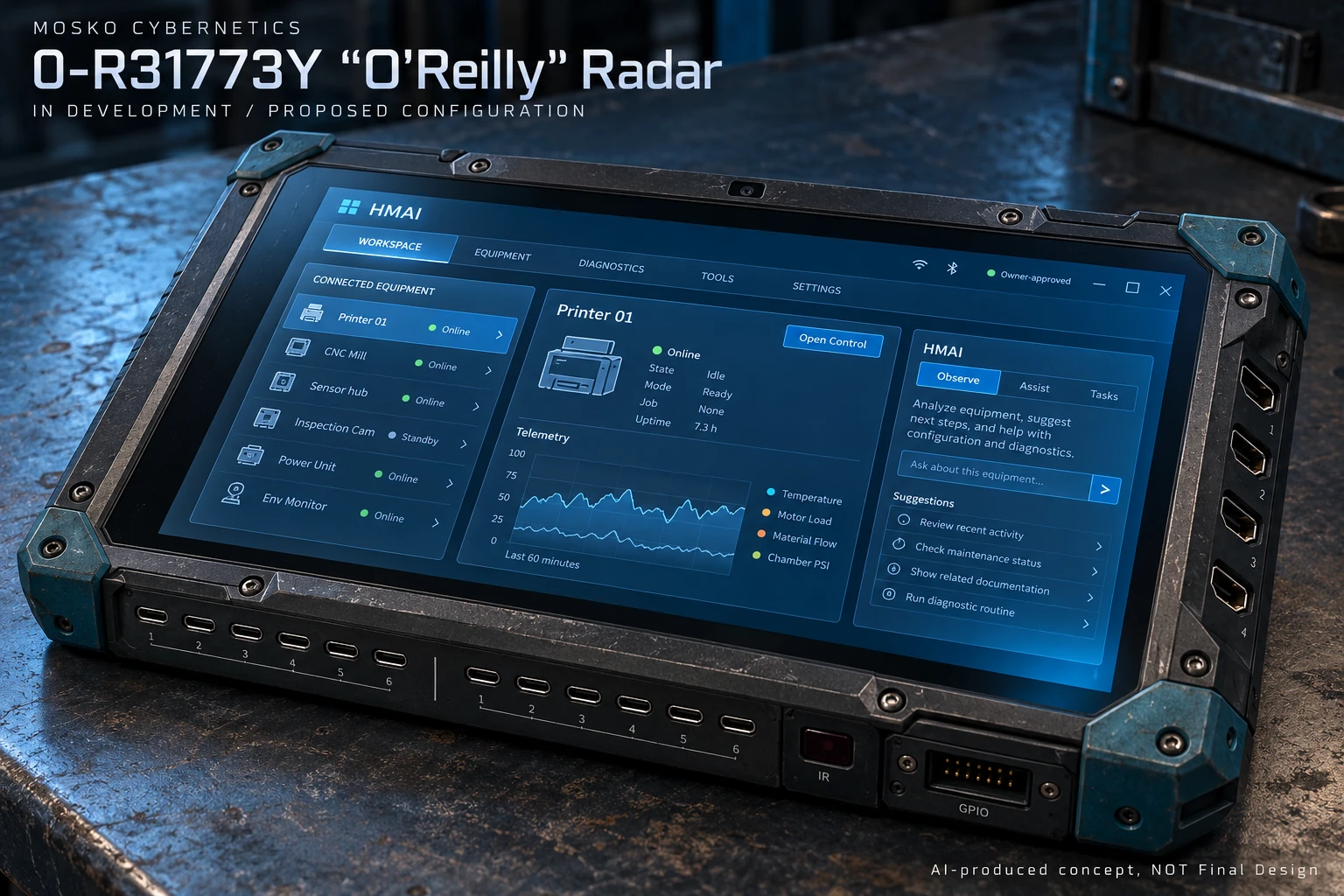
Concept render of a rugged tablet with two rows of USB-C ports, HDMI, infrared, and GPIO connectors, its screen showing connected equipment, telemetry, and an HMAI assistant panel.
AI-produced concept, NOT Final Design

Gen One / 03

0-R31773Y Radar “O’Reilly Radar”

In development. Connection counts and compatibility are design targets.

O’Reilly Radar is a dedicated tablet project for understanding and working with connected equipment. Its planned HMAI interface is a smaller, task-focused relative of Binat Natonim, intended to gather data, explain relevant system state, and help coordinate permitted actions. The proposed connection set includes infrared, GPIO, BLE, twelve USB-C ports, and four HDMI ports. Radar is intended to keep supported tools and their information close at hand across workshops, studios, and other technical environments.

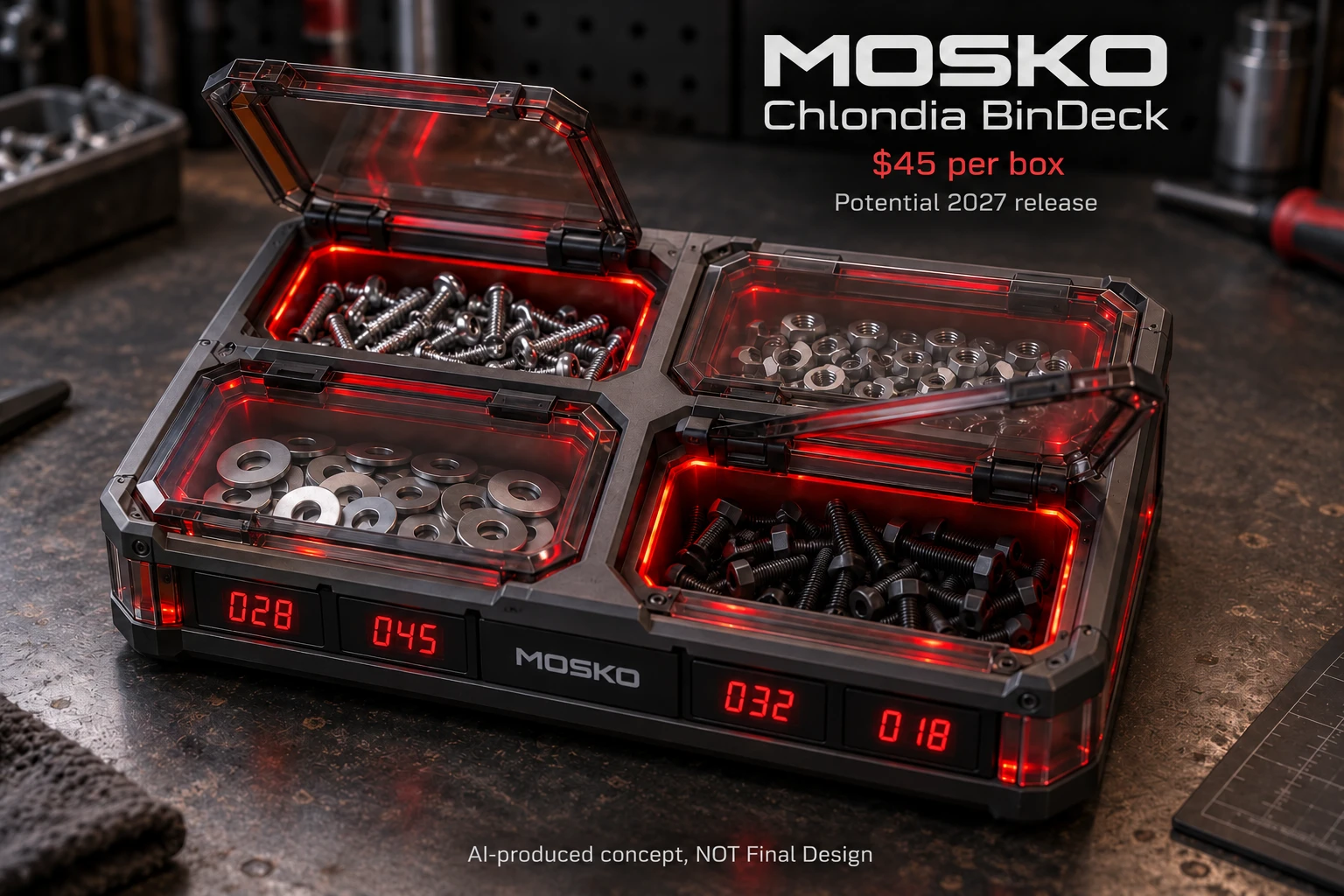
Concept render of a four-tray parts organizer with clear lids, red edge lighting, and a red numeric count display under each tray of screws, nuts, washers, and bolts.
AI-produced concept, NOT Final Design

Gen One / 04

Chlondia BinDeck

Development shelved. 2027 release planned.

BinDeck is MOSKO’s experimental storage system for keeping small parts organized and easier to account for. The project uses four removable trays and explores estimating remaining quantities from calibrated weight readings, with a known part type assigned to each tray. Development is currently shelved, but a 2027 release remains planned.

Estimated price: about $45 per box. Development data from BinDeck 0.7 points to a likely cost of $40–60 per box. Electric, smart storage for small parts is mostly found in industrial inventory systems, not on everyday workbenches. MOSKO plans to change that.

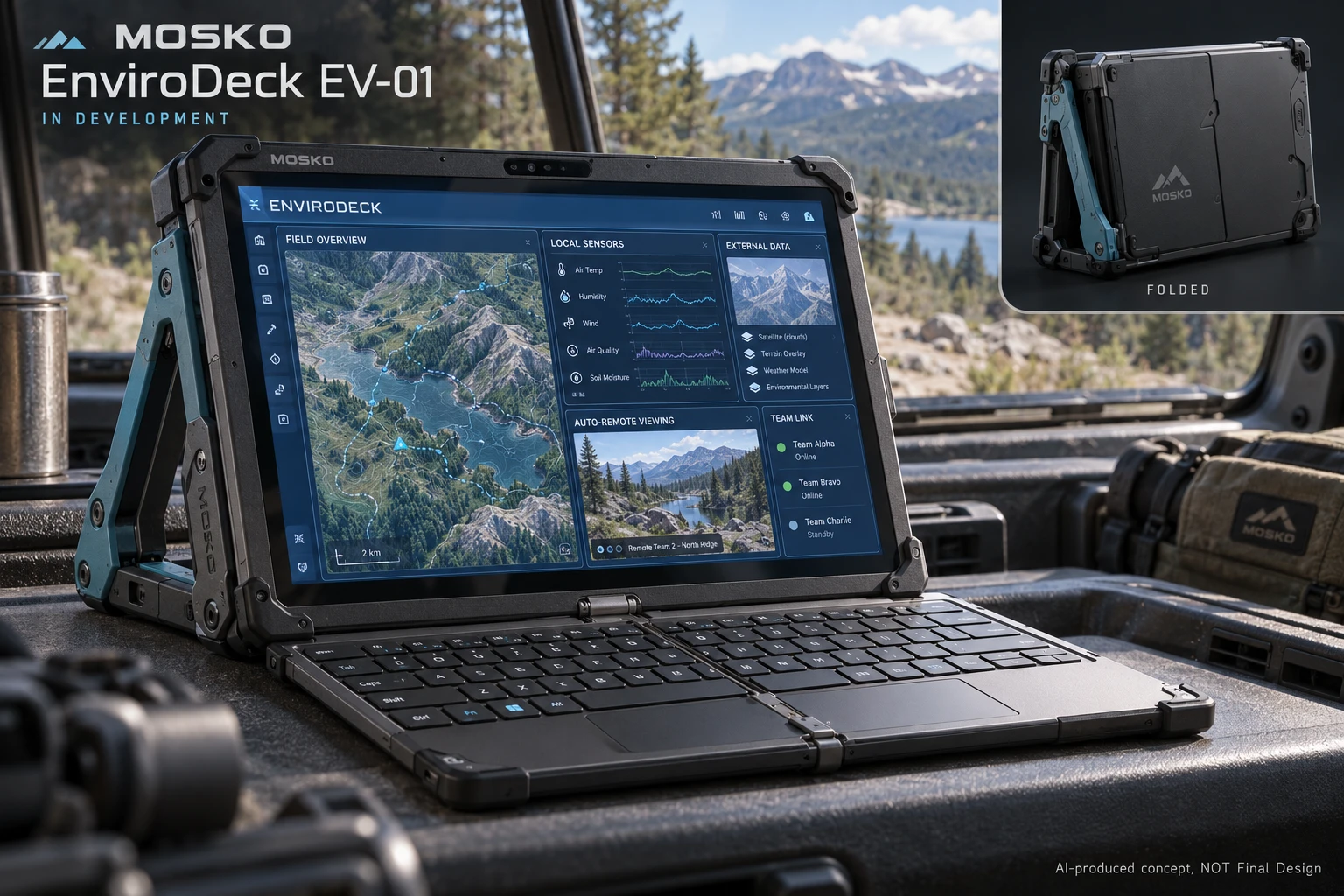
Concept render of a rugged folding field computer with a keyboard on a vehicle dashboard, showing terrain maps, sensor graphs, and team status, with an inset of the device folded.
AI-produced concept, NOT Final Design

Gen One / 05

EnviroDeck EV-01

In development. Data sources, sensor configuration, and communications performance remain to be established.

EnviroDeck is a field-computing project for people whose work depends on understanding environmental conditions. It is intended to combine supported local measurements, external data feeds, and AI-assisted interpretation in a portable working interface. Proposed applications include rescue operations and other technical fieldwork. Its planned “auto-remote viewing” function would let authorized teams share readings and relevant views between connected EnviroDecks, helping people in different locations work from a shared picture of conditions.

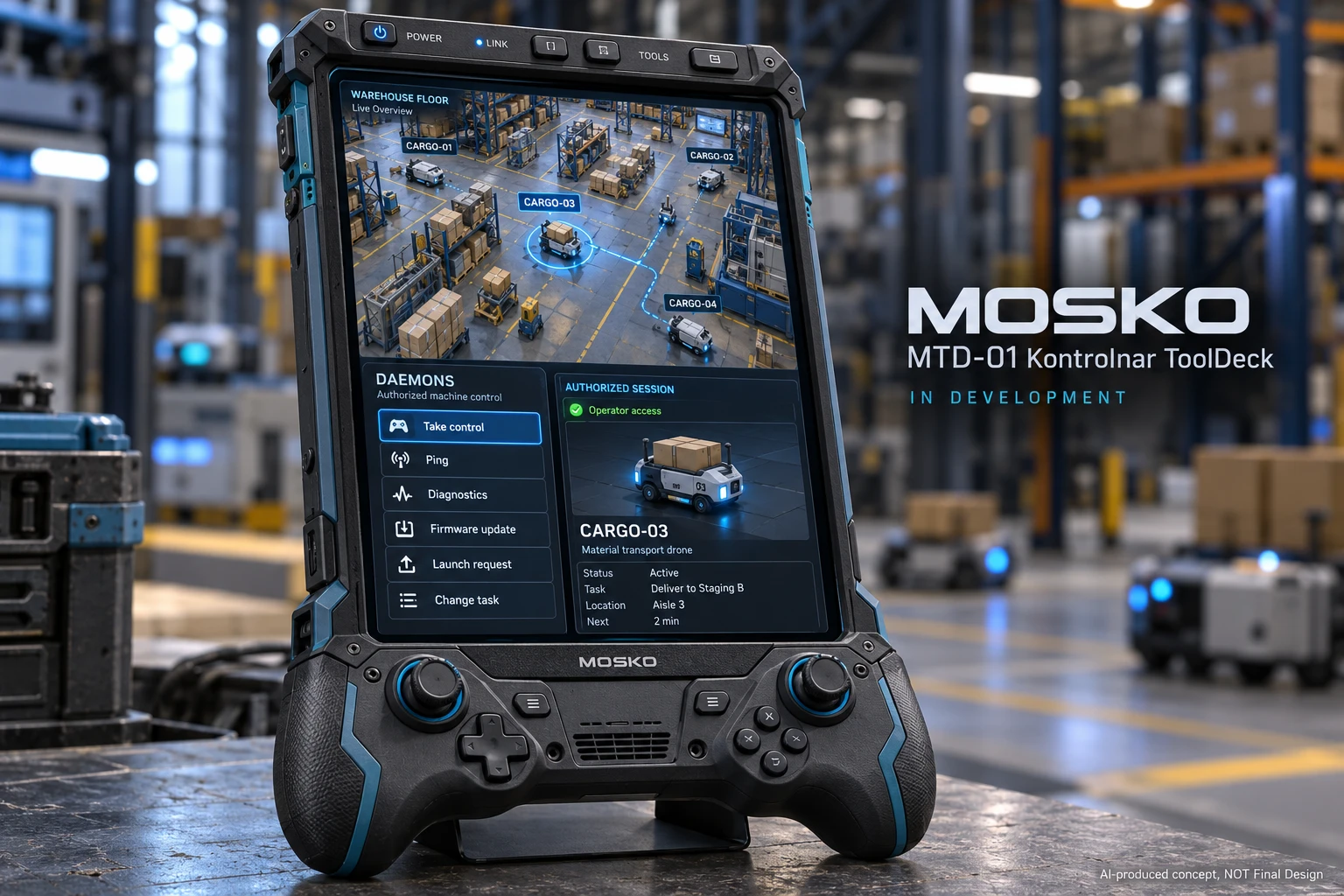
Concept render of a rugged portrait-format console with built-in gamepad controls, its screen showing a warehouse map and a daemon control panel for an authorized delivery drone.
AI-produced concept, NOT Final Design

Gen One / 06

MTD-01 Kontrolnar ToolDeck

In development. Facility integrations and control workflows to be validated.

Kontrolnar is a control-interface project for workshops, workstations, offices, and larger facilities. It is intended to bring supported machines and building systems into an operator’s working environment, with explicit authority for each connected resource and action. A target workflow is coordinating a shutdown across a group of authorized 3D printers from one command. The goal is broad, practical remote control, shaped by the equipment’s actual interfaces and the permissions its owner grants.

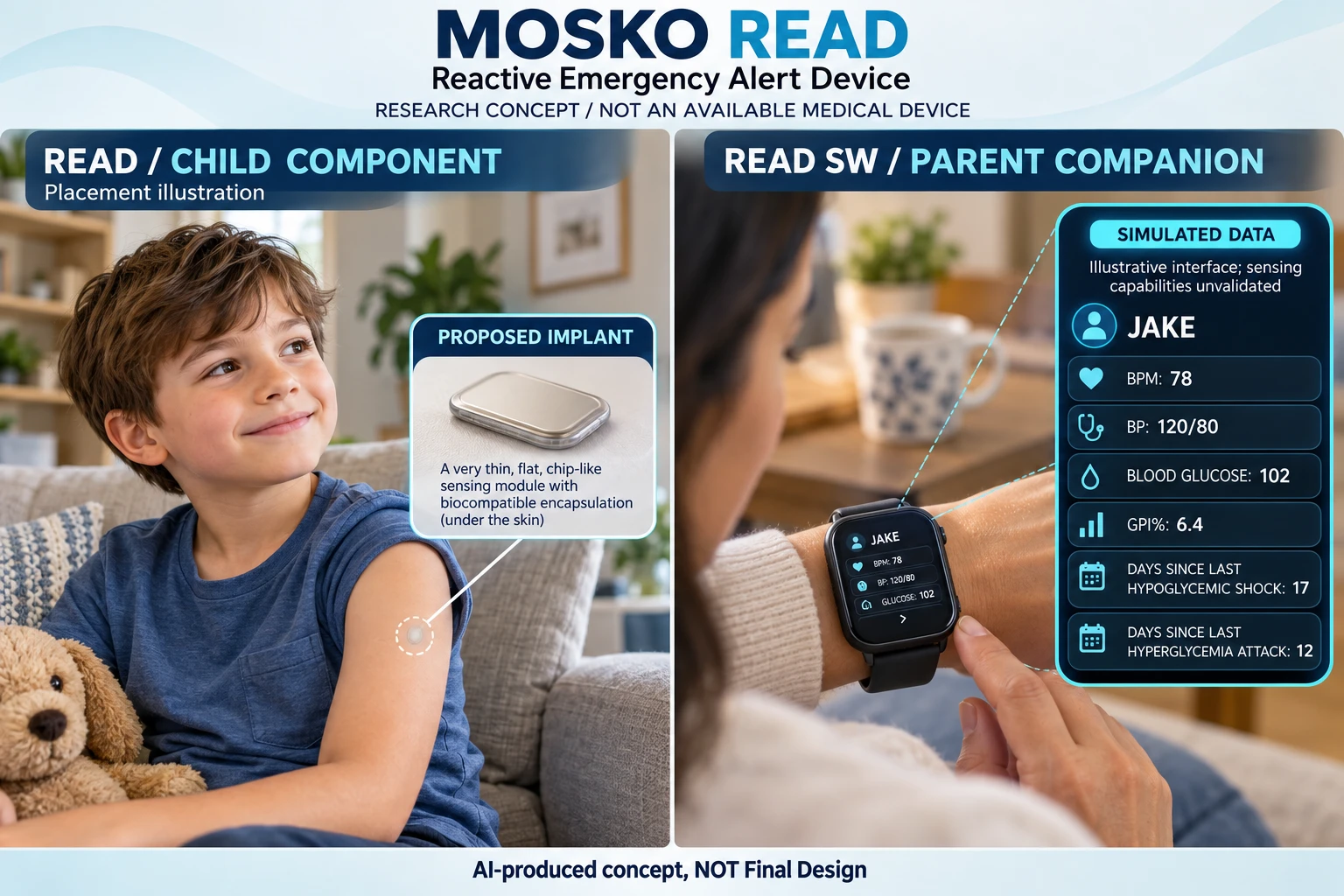
Two-panel concept illustration: a child on a sofa with a marked spot on the upper arm for the proposed under-skin sensing module, and a parent's smartwatch showing simulated health readouts.
AI-produced concept, NOT Final Design

Gen One / 07

READ Reactive Emergency Alert Device

Exploratory health-device research. Intended pediatric population and measurement capabilities have not been validated.

READ is a two-part emergency-alert research project for young children who are disabled, injured, or ill. A small implanted sensing component is intended to detect emergency events affecting the child. A companion device for the parent, worn like a smartwatch, is intended to turn the child’s readings into summaries and metrics, and to alert the parent the moment an emergency is detected. The goal is round-the-clock watch over a vulnerable child without a parent having to stay in the same room.

READ is built to flag emergencies, not to surveil a child. Research goals include heart-related measurements, sleep information, and possible EEG recording, subject to sensor design and validation. It is not currently available as a medical device.

Questions about the first generation?

Start a conversation.

Contact MOSKO